Lefty Loosie
(2017)
Earliest I remember anything feeling wrong about my walk was in my late teens, trying to walk in heels like a star. My left leg was shaky and I couldn't stand up straight. But rather than trying to learn, I felt as an out lez in the '90's I could march through life in Doc Martens forever like it was a choice. A statement, even! I moved from CA to NY in August of 2001 and each succeeding blazing-hot summer, footwear became more challenging. I would lose flip flops off my left foot, and eventually flats would fly off too. My foot would just slip out of them. I would fall down if the sidewalk was uneven (i.e. often!). My left leg dragged and my hip started to dip. My whole gait had changed so insidiously I didn't address it.
In 2014 I finally got medical insurance through a job, and asked for help with my weak and shrinking leg. Back in CA by then, I got bounced around to a few different doctors, then finally got a referral for an AFO 2 years later. A technician made a cast of my foot and lower leg and a custom brace would be made for me. I really wanted a sleek something that could help me walk in any shoe anywhere. What I got was this humble device:
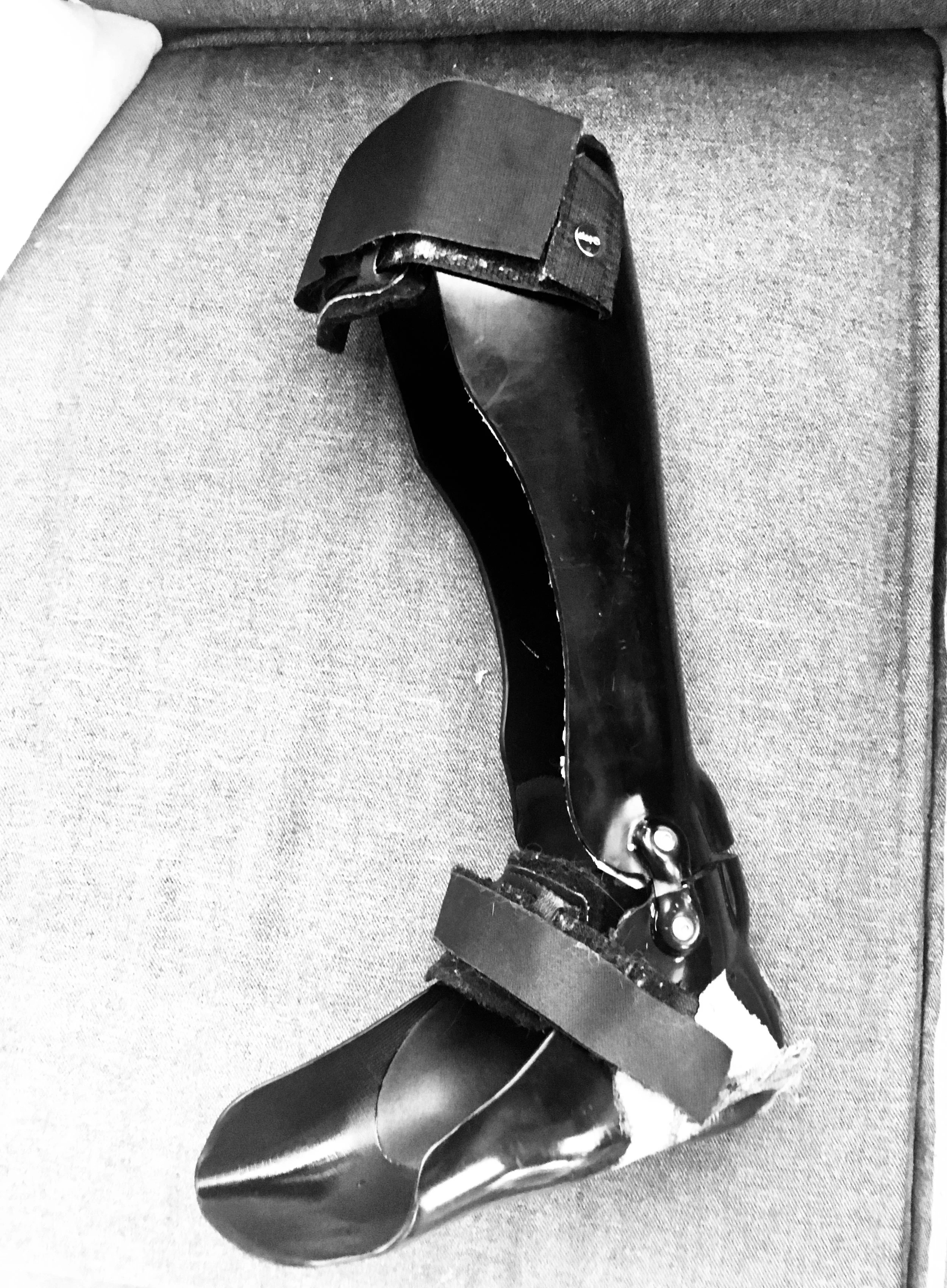
It may seem shallow to be disappointed in this, but the well-spring of AFO choices cannot be described as deep, much less efficient, user-friendly, or attractive. Imagine if your footwear options were limited to the most rudimentary, cost-effective assurances that you would not fall down or harm yourself. This is the best solution that experts have for my problem, and after a century of modular modern design and engineering it's hard to believe that this is the best anyone can do.
Bondage
I remember watching Of Human Bondage (1934) as a teenager multiple times. I hardly took in the plot. I was there to bask in the glamour of Bette Davis and Leslie Howard; their baffling blonde perfection, his gorgeous androgyny and inner torment, her scenery-eating cruelty and TB-chic demise. It's been years since my last viewing, but from what I remember, Howard's protagonist, Philip, is doomed by two forces: physical malady and romantic obsession with Mildred, played by Davis.
Throughout the film, there is an implied link between his corporeal weakness (he walks funny) and his powerlessness against Mildred's manipulations (she plays on his feelings to get financial support, verbally abuses him, trashes his place, burns his med school tuition, flees, comes back when she needs more support, gets him to leave a healthy relationship, leaves him again, has a baby, loses the baby, and ends up a destitute prostitute having nearly ruined his one whole chance at life and he's still bewitched). By the end of the film she is dead and a surgery has fixed his club foot and the music tells us he can now finally be free.
I remember the feeling that I wasn't picking up all of what 'Of Human Bondage' was laying down. I didn't understand the title or what 'bondage' even referred to. I got the subversive kink aesthetic but it was clearly not relevant here, so beyond that it was a big shrug. At some point in the film Leslie Howard and the lovely woman-he-shouldn't-have-ditched-for-Bette talk about being "bound" to another human by the heart, but I think ultimately the film was saying that we are slaves to our weaknesses and desires and that those two things are basically the same. It's clear to me now that this is an awful, awful message, but back then I was beguiled by the glamorous idea that I'd be doomed, bound by my romantic heart.
When teenage-me thought about this movie, I thought mostly of this:
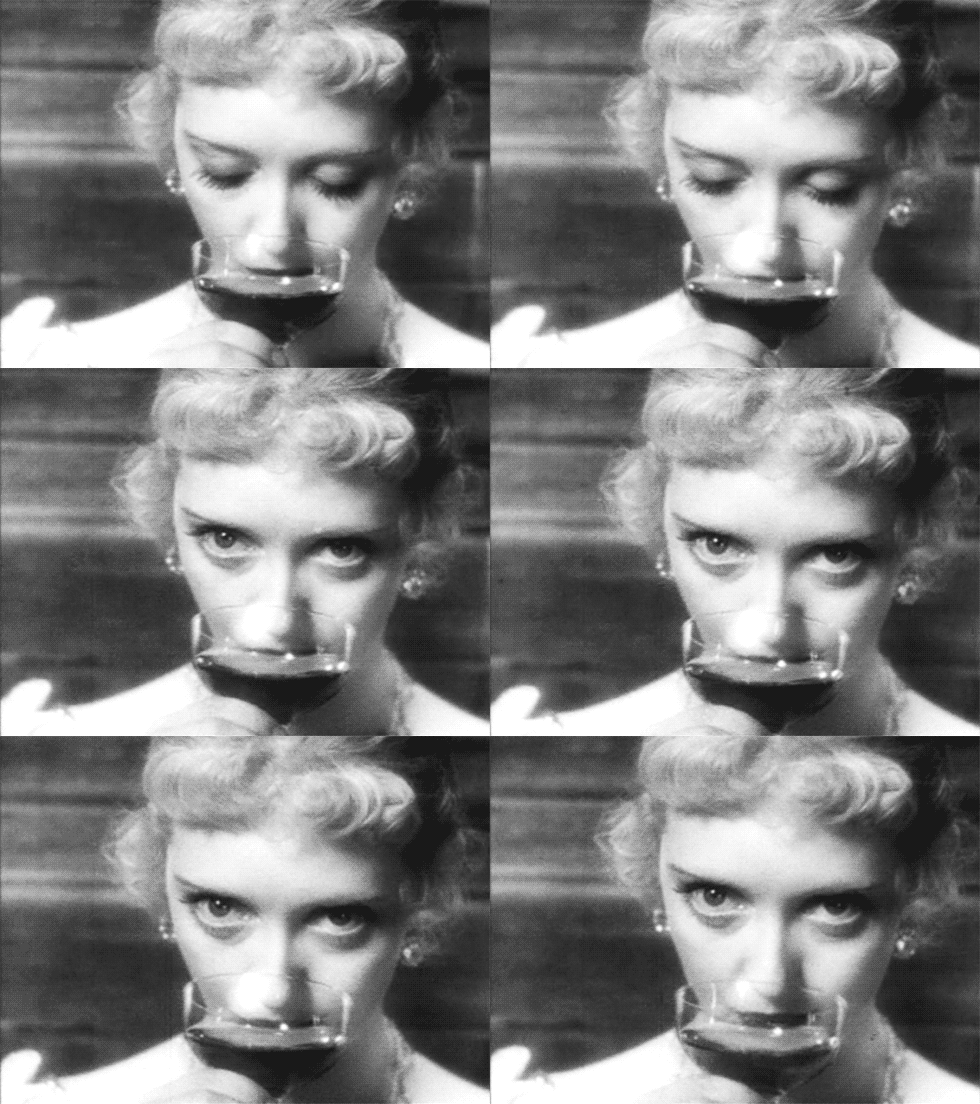
Thinking of it now, I see a less gif-licious image: that of the Howard's feet, clad in hard, cumbersome, corrective shoes, struggling to walk through a dark London night. The camera fixates on his walk for some time; we're meant to feel his burden. I used to think it was a tiresome device, but now I see its power. I think of the feeling of being bound by my own body, it's pain and weakness, and having to literally carry it everywhere I go.
Philip's condition is crudely-but-officially called "Club Foot" It's similar to what I have, but my diagnosis is "Foot drop.*" While I remain hopeful for advancements in the world of orthotic design, I have softened to this rig. It is functional and sturdy and I walk better with it. It's also a helpful signal to strangers that I have a disability.
It tends to be straight-presenting male strangers who ask me "what happened, were you in a (sic) accident?" in reference to my foot brace. Depending on the kind of day I'm having I might say, "muscular atrophy," or "nah, it's a spinal thing," or just, "yep." The faces drop when the penny does: it's not the kind of thing that gets better. For me, the burden of that fact isn't a fixed weight. Some days it feels like a lead blanket, other days not. Today I can take comfort that I'm not in Philip's shoes, for the love of my life gives me joy and pleasure, never torment, and even though a surgeon will never rid me of this disability, I can find power (i.e. freedom) in the things I can do. It's hard feckin' work but it's the only job I've got right now.
*Looking up Club Foot for this has shown me that Club Foot might be a more accurate diagnosis for me. Even though it wasn't noticeable at birth, it's gotten progressively weak over time. My foot turns in. It droops too so maybe it's both club and drop foot. I'll let you know.